
Introduction
In the age of artificial intelligence (AI) and machine learning (ML), data has become one of the most valuable resources in the world. From healthcare to finance, from retail to autonomous vehicles, AI systems rely heavily on large, diverse, and high-quality datasets to function effectively. However, collecting and using real-world data often comes with challenges—privacy risks, biases, high costs, and regulatory restrictions. To overcome these barriers, a new solution has emerged: synthetic data.
Synthetic data, which is artificially generated rather than collected from real-world events, is transforming how industries approach AI development. It is enabling faster innovation, stronger privacy protections, and new opportunities for growth. This article explores what synthetic data is, how it works, its applications, challenges, and why it is key to the future of AI.
What is Synthetic Data?
Synthetic data refers to information that is not gathered from real-world individuals or systems but created artificially using algorithms, simulations, or generative models. Despite being artificial, it accurately reflects the statistical properties and structures of real-world data.
For example, instead of collecting millions of sensitive patient records, a healthcare company can generate synthetic datasets that mimic real patients’ information without exposing private details. Similarly, a self-driving car company can create simulated driving scenarios—such as extreme weather or rare accidents—that would be nearly impossible to capture in the real world.
How is Synthetic Data Created?
The creation of synthetic data involves advanced methods, including:
-
Generative Adversarial Networks (GANs) – A machine learning approach where two neural networks compete with each other to produce highly realistic synthetic images, videos, or text.
-
Rule-Based Models – Structured data generated according to predefined statistical rules, often used in industries like finance and healthcare.
-
Simulation and Digital Twins – Virtual models of real-world systems (like traffic networks or factories) that generate realistic data for testing.
-
Agent-Based Modeling – Artificial agents mimic human-like behavior in simulated environments to generate behavioral or decision-making datasets.
These methods allow organizations to create synthetic datasets that are both realistic and diverse.
Applications of Synthetic Data
1. Artificial Intelligence Training
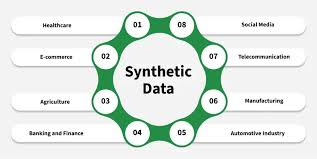
AI models need vast amounts of data for training. Synthetic data ensures that models have access to large, balanced, and high-quality datasets. Autonomous vehicle companies, for example, train their systems on billions of miles of simulated driving data, including rare or dangerous situations.
2. Healthcare and Medicine
Patient privacy is one of the biggest challenges in healthcare. Synthetic patient data allows researchers to develop diagnostic models, test new treatments, and conduct medical studies without exposing sensitive records. This accelerates medical innovation while keeping patient data safe.
3. Finance and Banking
Banks and financial institutions use synthetic transaction data to train fraud detection systems, test risk management strategies, and comply with strict data privacy laws. It enables secure innovation while protecting customer trust.
4. Cybersecurity
Testing cybersecurity systems on real-world threats is risky. Synthetic attack data provides safe testing environments, helping organizations strengthen their defenses against malware, ransomware, and phishing attempts.
5. Retail and Marketing
Businesses generate synthetic consumer behavior data to predict trends, test new product launches, and personalize shopping experiences—all without directly tracking individuals.
6. Government and Smart Cities
Governments use synthetic data to model urban traffic, test emergency response strategies, and plan infrastructure development while avoiding citizen privacy issues.
Benefits of Synthetic Data
-
Privacy and Compliance – Since it is artificially generated, it protects personal identities and aligns with regulations like GDPR and HIPAA.
-
Cost-Effective – Collecting large-scale real-world data is expensive; synthetic data reduces costs significantly.
-
Scalability – Organizations can instantly generate massive amounts of data for training large AI models.
-
Bias Reduction – Synthetic datasets can be designed to balance underrepresented groups and reduce bias in AI systems.
-
Accessibility – Smaller companies and startups gain access to data resources that were previously limited to big corporations.
Challenges of Synthetic Data
Despite its potential, synthetic data is not without challenges:
-
Quality Issues – Poorly generated synthetic data may not reflect real-world complexity.
-
Generalization Risks – AI models trained only on synthetic data may struggle with real-world scenarios.
-
Bias Transfer – If the original dataset is biased, the synthetic data may also inherit those biases.
-
Validation Difficulty – Determining how “realistic” synthetic data is remains an ongoing challenge.
-
Adoption Barriers – Some industries are cautious about replacing real-world data with synthetic alternatives.
The Future of Synthetic Data
As AI continues to evolve, the demand for data will far exceed the availability of real-world datasets. By 2030, experts predict that most AI training will rely on synthetic data. With the rise of advanced generative AI models, the quality of synthetic data will continue to improve, making it nearly indistinguishable from real-world data.
Synthetic data will also play a crucial role in federated learning, privacy-preserving AI, and the development of digital twins for industries like healthcare, energy, and smart cities. Regulations around data privacy will further accelerate adoption, making synthetic data not just an option, but a necessity.
Conclusion
Synthetic data is revolutionizing the way industries innovate and protect privacy in the digital age. By combining scalability, cost-efficiency, and ethical responsibility, it addresses many of the biggest challenges of real-world data collection. From healthcare to finance, from cybersecurity to retail, synthetic data is enabling breakthroughs that were once impossible.
While challenges remain—such as ensuring quality and preventing bias—the momentum behind synthetic data is undeniable. In the near future, it will become the foundation of AI development, driving progress across every sector.
In essence, synthetic data is not just artificial—it is a powerful engine for real innovation, shaping a future where artificial intelligence is smarter, safer, and more inclusive.
