
Introduction
Let’s be honest, when people hear the phrase “hedge fund level technical,” it sounds like Wall Street wizardry. You probably imagine rooms filled with high-speed servers, screens flashing with colourful charts, and traders in sleek suits murmuring about “alpha,” “volatility,” and “liquidity.” Well, that’s not entirely wrong!
But beyond the buzzwords lies an intricate system, a perfect blend of mathematics, psychology, and technology used to gain even the slightest edge in the market. Hedge funds operate in a world where milliseconds can mean millions, and data isn’t just analysed; it’s weaponised.
In this article, we’ll unravel what it truly means to operate on a hedge fund level technical scale. We’ll explore the tools, thought processes, and secret sauce that make hedge funds some of the most technically advanced entities on the planet. And hey, don’t worry, we’ll break it all down in plain English (with a sprinkle of excitement along the way).
What Does “Hedge Fund Level Technical” Really Mean?
Before we dive into the deep end, let’s define the term. Hedge fund-level technical refers to the advanced analytical, computational, and strategic capabilities that top-tier hedge funds employ to make high-precision investment decisions.
We’re not talking about your average retail trading setup with a few charts and indicators. Nope, this is about:
-
Quantum-grade data processing that handles terabytes of market info in real-time.
-
Algorithmic trading models running 24/7, constantly learning from patterns.
-
Machine learning frameworks trained on decades of price data.
-
Infrastructure that’s closer to a NASA control room than a brokerage account.
It’s the ultimate intersection of technology, finance, and human psychology, a game where precision meets prediction.
The Evolution of Technical Mastery in Hedge Funds
From Gut Feeling to Quantitative Genius
Back in the day, traders trusted their instincts. They’d watch tape, read market sentiment, and follow trends using simple moving averages. But as markets got more complex and competitive, gut feeling wasn’t enough.
Enter the quant revolution, the rise of data scientists, mathematicians, and computer engineers on Wall Street. These brainiacs introduced advanced models that could crunch numbers faster than any human ever could.
Today, hedge funds like Renaissance Technologies, Two Sigma, and Citadel operate more like tech firms with trading licenses than traditional investment houses.
Technology Takes the Wheel
With algorithmic trading, milliseconds can make or break a deal. Modern hedge funds use:
-
Co-location servers are placed next to stock exchange data centres to reduce latency.
-
Custom-coded algorithms that analyse thousands of assets simultaneously.
-
Machine learning tools that adapt to market conditions on the fly.
-
Sentiment analysis engines are scraping millions of news articles and tweets every minute.
That’s hedge fund level technical, where precision and prediction merge into one.
Anatomy of a Hedge Fund Level Technical Operation
1. Data: The New Gold
Hedge funds thrive on data structured, unstructured, clean, messy it doesn’t matter. Every piece tells a story.
They don’t just look at stock prices; they analyze satellite imagery of store parking lots, shipment tracking data, consumer reviews, and even weather patterns.
Why? Because the tiniest clue can hint at a company’s future performance. For example:
-
A surge in online search traffic might signal growing interest in a brand.
-
Empty parking lots could reveal declining retail sales.
-
Positive social sentiment could predict a stock rally.
The more data you have, the sharper your edge.
2. Algorithms: The Silent Traders
If hedge funds were symphonies, algorithms would be their conductors.
These aren’t your run-of-the-mill trading bots; they’re sophisticated programs designed to:
-
Detect patterns invisible to humans.
-
Execute trades within microseconds.
-
Adjust risk exposure in real time.
-
Learn continuously from market fluctuations.
These models rely on deep learning and reinforcement learning, where systems improve by trial and error, kind of like how humans learn, but at lightning speed.
3. Risk Management: The Unsung Hero
You might think hedge funds are all about big bets, but ironically, their secret lies in risk control.
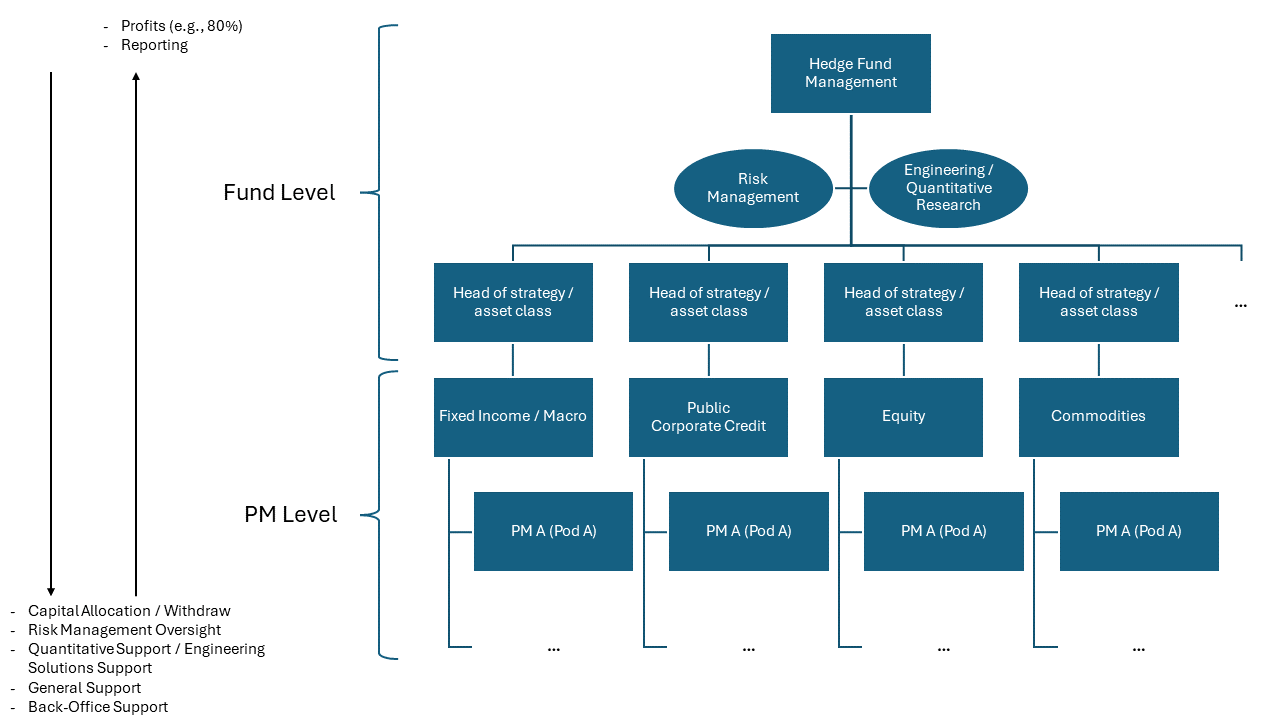
Every decision, every trade, every allocation is measured against potential loss. Advanced mathematical models like Monte Carlo simulations and Value at Risk (VaR) predict how portfolios might react under stress.
Simply put: hedge funds aren’t just chasing profits; they’re protecting them.
4. Human Oversight: The Brain Behind the Machine
Despite all the automation, humans still play a crucial role. Portfolio managers, data scientists, and analysts collaborate to interpret what the machines find.
They’re the ones asking the tough questions:
-
“Why did this model fail under certain conditions?”
-
“What hidden bias could be skewing our predictions?”
-
“Are we overfitting the data?”
Because even the most sophisticated system needs human intuition to steer it wisely.
The Secret Weapons of Hedge Fund Technical Teams
Want to peek behind the curtain? Here are a few insider tools and techniques:
-
Natural Language Processing (NLP): For scanning global news feeds and extracting actionable sentiment.
-
Statistical Arbitrage Models: Detect mispricings between correlated securities.
-
Factor Analysis: Breaks down returns into components like momentum, value, or volatility.
-
Alternative Data Mining: Uses satellite images, credit card data, or even shipping records for predictive insight.
-
Backtesting Engines: Simulate trading strategies across decades of historical data to ensure reliability.
These tools form the backbone of a hedge fund-level technical arsenal.
Why Retail Traders Struggle to Compete
Let’s face it, while platforms like Robinhood and TradingView have democratised investing, there’s still a massive gap between retail traders and hedge funds.
Retail investors often lack:
-
Access to high-quality data (most rely on delayed or limited information).
-
Computational resources (hedge funds run on supercomputers).
-
Advanced risk models to balance exposure.
-
Institutional discipline (emotions often rule over logic).
It’s not that retail traders can’t win, it’s just that they’re playing chess against an opponent with a quantum computer.
Bridging the Gap: Learning from the Masters
While most people can’t replicate a hedge fund’s infrastructure, there are valuable lessons to apply:
-
Adopt a data-driven mindset. Don’t guess, analyse.
-
Test every strategy. Backtesting isn’t just for quants; it’s essential for everyone.
-
Control emotions. Discipline beats excitement every single time.
-
Automate when possible. Even basic algorithmic tools can eliminate human bias.
-
Never stop learning. The market evolves daily, so should you.
Becoming hedge fund-level technical doesn’t require billions, just consistency, curiosity, and continuous learning.
Common Myths About Hedge Fund Technicals
Let’s bust a few misconceptions:
Myth 1: Hedge funds always win.
Nope! They just lose less often and recover faster.
Myth 2: It’s all automated.
While machines do the heavy lifting, humans still guide the strategy.
Myth 3: You need a PhD to understand it.
Not at all. Anyone can grasp the fundamentals with patience and the right mindset.
Myth 4: Hedge funds are only for the ultra-rich.
While investing in them is expensive, understanding their strategies is free and incredibly valuable.
The Future of Hedge Fund-Level Technical Innovation
Technology’s pace is blistering, and hedge funds are riding the wave. Here’s what’s next:
-
Quantum Computing: Soon, quantum algorithms may optimise trades faster than ever.
-
AI Agents: Autonomous AI traders could run mini-portfolios with self-evolving logic.
-
Blockchain Analytics: Funds are already tracking on-chain data for early crypto insights.
-
Neurofinance Models: Emerging research links brain activity with market decision-making patterns.
In essence, hedge funds will continue to blur the line between man and machine.
FAQs: Hedge Fund Level Technical Explained
Q1: What makes hedge fund strategies “technical”?
They rely heavily on quantitative models, data science, and computational algorithms rather than intuition or simple chart reading.
Q2: Can retail investors learn hedge fund techniques?
Absolutely! You can study quantitative analysis, algorithmic trading, and risk modelling online for free.
Q3: How much data do hedge funds use?
The biggest funds process petabytes of information equivalent to millions of books single day.
Q4: Is AI replacing human traders?
Not entirely. AI enhances decision-making but still needs human oversight for context, creativity, and ethics.
Q5: Which hedge funds are the most technically advanced?
Firms like Renaissance Technologies, D.E. Shaw, Two Sigma, and Citadel are often cited as leaders in the hedge fund-level technical arena.
Conclusion: The Edge Lies in the Details
At its core, hedge fund-level technical mastery isn’t just about technology; it’s about precision, discipline, and relentless innovation. These firms don’t chase trends; they anticipate them. They don’t just play the game, they redefine it.
But here’s the kicker: you don’t have to be a billionaire to think like a hedge fund. By applying their principles, data-driven decisions, rigorous testing, and emotional control, you can elevate your own investing to a whole new level.
So next time you see a flickering stock chart or a market headline that seems overwhelming, remember: beneath all that chaos lies an elegant rhythm. The question is—are you ready to dance to the hedge fund level technical beat?
