
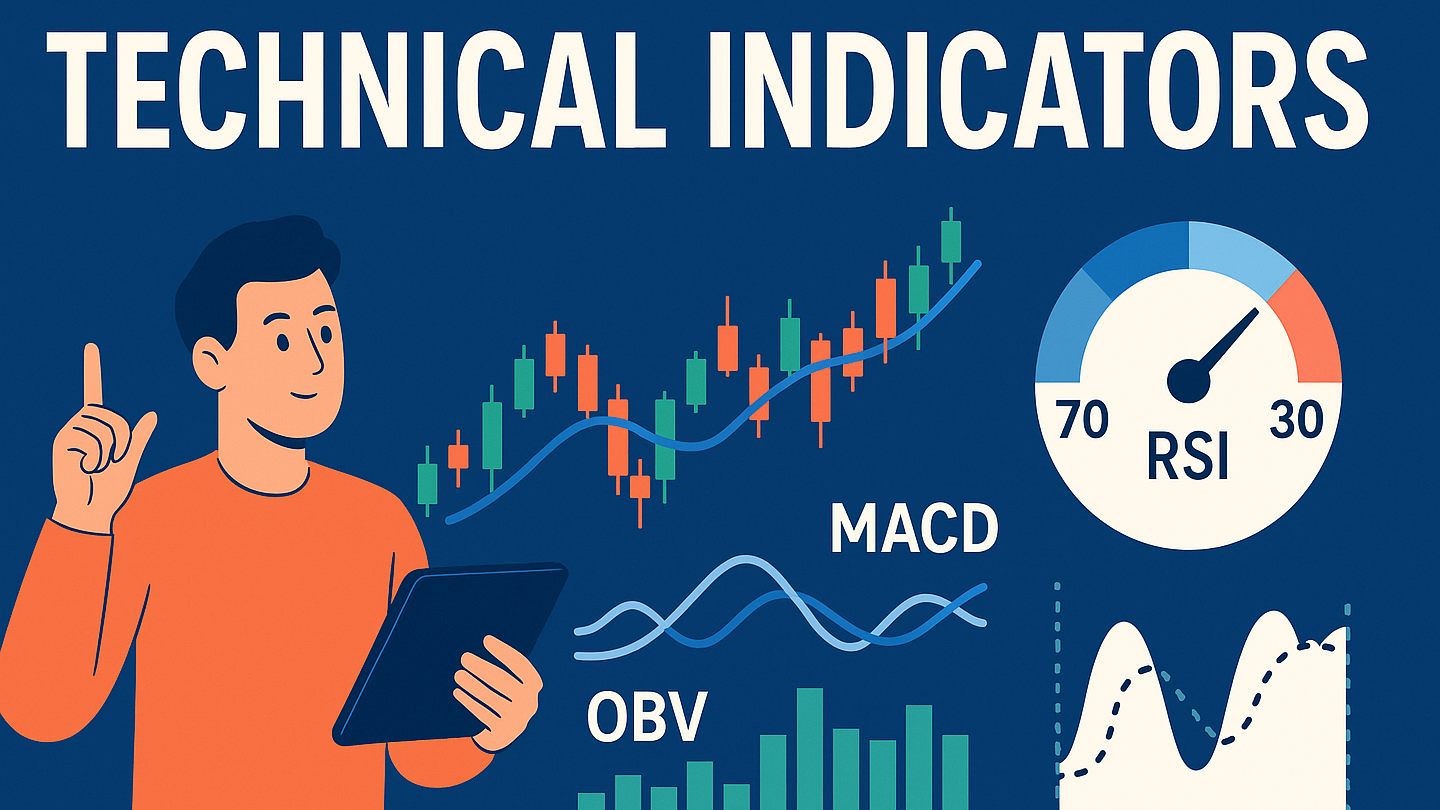
Introduction
Ever wondered how traders seem to “predict” where the market’s heading? Like, do they have some secret insider info—or maybe a magic crystal ball hidden somewhere? Nope! What they really rely on are technical indicators, those nifty mathematical tools that help decode the behaviour of prices, trends, and market sentiment.
Whether you’re dabbling in crypto, forex, stocks, or commodities, these indicators are your bread and butter for making informed moves instead of blind guesses. Think of them as your trading GPS guiding you through the twists and turns of the market so you don’t end up lost in the financial wilderness.
But hold on before you dive headfirst into candlestick charts and oscillators, let’s take a deep breath and break this down. In this article, we’ll explore what technical indicators are, how they work, the types you need to know, and even a few pro tips to make the most of them.
So, grab your mental toolkit and let’s crack the code of the market!
What Exactly Are Technical Indicators?
In simple terms, technical indicators are formulas or algorithms that analyse historical price, volume, or open interest data. They help traders identify trends, potential entry and exit points, and areas of strength or weakness in a market.
Think of them as signposts on a trading map, each one pointing toward something meaningful: momentum, volatility, or direction.
The Core Idea Behind Indicators
The principle is simple yet powerful: history often repeats itself. Prices tend to move in patterns, and by studying these patterns, traders can anticipate future behaviour. Technical indicators quantify these patterns in real-time, allowing you to spot opportunities (and traps!) before everyone else does.
The Two Main Camps: Leading vs. Lagging Indicators
Not all indicators are created equal. Some tell you what might happen next, while others confirm what’s already happening. Let’s unpack the difference.
1. Leading Indicators – The Fortune Tellers
Leading indicators try to predict future price movements. They’re like the early-warning systems of the market, hinting when a trend might be about to start or end.
Common examples include:
-
Relative Strength Index (RSI) – Measures overbought or oversold conditions.
-
Stochastic Oscillator – Compares closing prices to a range of prices over a set period.
-
Commodity Channel Index (CCI) – Highlights cyclical price movements.
These are great for traders who love to get in early—but beware, leading indicators can also give false signals if the market suddenly shifts direction.
2. Lagging Indicators – The Confirmers
Lagging indicators, on the other hand, are the “show me the proof” type. They rely on past data and confirm trends after they’ve already started.
Popular examples include:
-
Moving Averages (MA) Smooth out price fluctuations to show trends.
-
Moving Average Convergence Divergence (MACD) – Reveals changes in momentum.
-
Bollinger Bands indicate volatility and potential reversals.
They might not give you the earliest signal, but they’re generally more reliable when identifying established trends.
Must-Know Technical Indicators Every Trader Should Master
Let’s roll up our sleeves and dig into some of the most popular and powerful technical indicators that traders swear by.
1. Moving Averages (MA) – The Trend Whisperer
The moving average is perhaps the simplest yet most widely used indicator. It smooths out the price data to show a clearer trend direction.
-
Simple Moving Average (SMA): The arithmetic mean of prices over a specific time frame.
-
Exponential Moving Average (EMA): Puts more weight on recent prices, reacting faster to new data.
Pro Tip:
When a short-term EMA crosses above a long-term one, that’s often seen as a bullish signal (aka a good time to buy). The reverse? Bearish.
2. Relative Strength Index (RSI) – The Emotion Detector
Markets are driven by human behaviour, greed, fear, impatience, excitement, and RSI quantifies that.
The RSI measures the speed and change of price movements on a scale from 0 to 100.
-
Above 70 → Overbought (a potential sell signal).
-
Below 30 → Oversold (a potential buy signal).
In short, it tells you when traders are getting too emotional and the market might correct itself soon.
3. MACD – The Momentum Tracker
The Moving Average Convergence Divergence (MACD) is a mouthful, but it’s incredibly insightful. It measures the relationship between two moving averages (usually 12-day and 26-day EMAs).
When the MACD line crosses above the signal line, it often hints at a bullish trend. When it crosses below, that’s bearish territory.
4. Bollinger Bands – The Volatility Gauge
Created by John Bollinger, these bands wrap around a moving average and expand or contract based on market volatility.
-
When bands tighten, Low volatility, potential breakout ahead.
-
When bands widen, High volatility, potential trend exhaustion.
It’s like watching a rubber band stretch; it can only go so far before snapping back!
5. Fibonacci Retracement – The Golden Ratio of Trading
Ah, the Fibonacci sequence is a mathematical marvel that appears everywhere, from seashells to stock charts.
Traders use Fibonacci retracement levels to identify potential support and resistance zones. Common ratios include 38.2%, 50%, and 61.8%.
When prices pull back to one of these levels and bounce, it’s often a strong indicator of trend continuation.
How to Combine Technical Indicators Like a Pro
Using just one indicator can be risky; it’s like trying to understand a movie by watching only one scene. The magic happens when you combine multiple indicators that complement each other.
The “Golden Trio” Strategy
A popular combo looks like this:
-
Moving Averages for trend direction.
-
RSI for momentum and emotion.
-
Bollinger Bands for volatility.
Together, they give you a balanced perspective: trend + strength + timing.
Example:
If the moving average is trending upward, the RSI is below 70, and Bollinger Bands show moderate volatility—you might have a solid buy opportunity.
Avoiding the Common Traps of Technical Analysis
Even the best traders fall into these traps sometimes. Here’s what to watch out for:
-
Indicator Overload: Using too many at once causes “analysis paralysis.” Stick to 2–4 solid ones.
-
Ignoring Fundamentals: Technicals show how prices move, not why. Always consider news or economic data.
-
Chasing False Signals: Markets love to fake breakouts. Always confirm with multiple indicators.
-
Forgetting Risk Management: No indicator can guarantee profits. Use stop-loss orders and manage your exposure.
FAQs About Technical Indicators
Q1: Do technical indicators work in all markets?
Yes, they’re versatile! Whether you’re trading crypto, forex, or stocks, these tools help decode price behaviour, though the settings may need tweaking.
Q2: Are technical indicators accurate?
They’re not foolproof, but they significantly improve your odds when used wisely. Think of them as probability tools, not prediction tools.
Q3: Can I trade using only one technical indicator?
Technically, yes. But relying on just one is risky. Combining a few that measure different aspects—trend, momentum, and volatility—works best.
Q4: What’s the best indicator for beginners?
Start with Moving Averages and RSI. They’re easy to understand, visually clear, and incredibly effective for learning price behaviour.
Q5: How do I know which indicators to trust?
Backtest them! Test each on historical data before applying it live. That way, you’ll know how it performs in different market conditions.
Advanced Tip: The Psychology Behind Technical Indicators
Here’s something few traders talk about: technical indicators are really just reflections of crowd psychology. When RSI spikes, it’s showing mass greed. When MACD dips, it reflects waning confidence.
Understanding that each line or bar on your chart represents collective human behaviour is key. Once you learn to “read” that psychology, you’ll start seeing the market as a living, breathing entity, one that reacts to emotion as much as logic.
Wrapping It Up: Making Sense of the Market
Let’s face the market can be a wild beast. Prices surge, plunge, and sometimes just laze around, leaving traders scratching their heads. But with technical indicators, you’re no longer guessing you’re interpreting.
These tools translate chaos into clarity, helping you make calculated moves instead of emotional ones. Whether you’re a day trader chasing quick wins or a long-term investor hunting big trends, mastering technical indicators gives you the edge you need to stay ahead.
So the next time you open a chart, don’t just stare at the candlesticks, listen to what the indicators are whispering. They’re not magical, but they’re as close to a secret language of the market as you’ll ever get
