
Introduction
In today’s digital world, data is often described as the “new oil.” It powers artificial intelligence (AI), machine learning (ML), and countless applications that shape our everyday lives. However, with the rise of AI, privacy concerns have also grown. Traditional machine learning methods usually require gathering all user data in a central location, which raises questions about security, data breaches, and user trust. Federated Learning (FL) has emerged as a revolutionary solution to these challenges. It enables collaborative training of AI models without requiring sensitive data to leave individual devices. This innovation is redefining how we think about collaboration, privacy, and the future of AI.
What is Federated Learning?
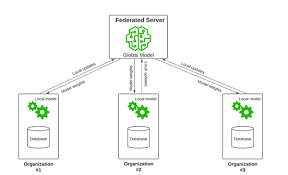
Federated Learning is a decentralized approach to machine learning. Instead of sending raw data to a central server, the process works in reverse: a shared AI model is sent to local devices—such as smartphones, tablets, or IoT devices—where it learns directly from the user’s data. Only the model updates (like improved parameters or weights) are sent back to the central server. The central server then aggregates these updates to create a stronger global model without ever accessing raw personal data.
In simpler terms, Federated Learning allows multiple parties to collaborate and train machine learning models while ensuring data never leaves its original source. This approach strikes a balance between the power of collective intelligence and the importance of data privacy.
Why Federated Learning Matters
The need for Federated Learning is growing rapidly due to two main factors:
-
Privacy Concerns: Users and governments demand stronger protection of personal data. Regulations like GDPR in Europe and CCPA in California emphasize strict rules around how organizations use data.
-
Data Explosion: The volume of data generated on personal devices is massive. From health apps to virtual assistants, data is often too sensitive to be stored centrally but too valuable to ignore.
Federated Learning ensures both sides are respected—it leverages massive amounts of distributed data while respecting user privacy.
Key Benefits of Federated Learning
1. Privacy Preservation
At the heart of FL is privacy. Because raw data never leaves a device, the risk of exposure during transmission or storage is minimized. This is particularly important for sensitive industries like healthcare, finance, and education.
2. Enhanced Security
Even if hackers target the central server, they won’t find raw personal data—only aggregated model updates. This reduces the chances of large-scale data breaches.
3. Collaboration Across Boundaries
Federated Learning allows organizations to collaborate without sharing raw data. For example, multiple hospitals can train a shared medical AI model without disclosing patient records to each other. This fosters collaboration while maintaining confidentiality.
4. Efficiency in Edge Computing
Since FL processes data locally, it reduces the need for continuous data transmission to cloud servers. This lowers network congestion and improves efficiency, especially in remote or bandwidth-limited areas.
5. Personalization
Federated Learning allows AI models to be both global and local. A global model is shared across all devices, while local fine-tuning ensures that the model adapts to individual user behavior. For example, a smartphone keyboard app can predict your typing style better without uploading all your keystrokes to a central server.
Real-World Applications of Federated Learning
1. Healthcare
Hospitals generate vast amounts of sensitive patient data, making central collection risky. Federated Learning enables hospitals across the world to train better diagnostic models while keeping patient records secure and private.
2. Finance
Banks and financial institutions are often restricted by strict data-sharing regulations. Through FL, they can jointly train fraud detection systems without compromising sensitive transaction details.
3. Smartphones and Smart Devices
Tech giants like Google and Apple use Federated Learning in their products. Google’s Gboard keyboard uses FL to improve word predictions and auto-corrections while keeping personal typing data on the device.
4. Internet of Things (IoT)
Smart home devices, connected cars, and wearable gadgets generate continuous streams of data. Federated Learning allows these devices to collaboratively improve AI systems—like voice recognition or predictive maintenance—without sending raw data to the cloud.
5. Education
Federated Learning can help schools and universities create better e-learning platforms by analyzing student performance trends collectively, without exposing individual student records.
Challenges of Federated Learning
While Federated Learning offers numerous advantages, it also comes with challenges:
-
Data Heterogeneity: Data stored on individual devices may vary significantly in quality and distribution, making it harder to train consistent models.
-
Communication Overhead: Sending frequent model updates to central servers requires stable internet connections, which may not always be feasible.
-
Security Risks: Although safer than centralized methods, FL is not immune to threats like model poisoning, where malicious updates can corrupt the global model.
-
Complex Implementation: Designing and maintaining FL systems requires significant technical expertise and infrastructure.
Future of Federated Learning
The future of Federated Learning looks promising. As industries become increasingly data-driven and regulations on privacy tighten, FL will play a vital role in shaping AI ecosystems. Advances in complementary fields like differential privacy, homomorphic encryption, and secure multiparty computation will further strengthen FL’s ability to protect data.
In the coming years, we can expect wider adoption across industries such as healthcare, finance, and autonomous vehicles. Governments and organizations may even set up federated networks where global challenges—like predicting pandemics or combating climate change—can be addressed collaboratively without sacrificing privacy.
Conclusion
Federated Learning is more than just a technical innovation—it represents a philosophical shift in how we approach data, collaboration, and privacy. By decentralizing AI training, FL ensures that sensitive data remains where it belongs: with the user. At the same time, it unlocks the potential of collective intelligence, allowing organizations to benefit from shared insights without compromising trust.
In an age where privacy is as valuable as performance, Federated Learning stands out as a transformative approach, redefining how AI can be built responsibly. It not only promises a safer digital world but also fosters a more collaborative and ethical future for artificial intelligence.
