
Introduction
When we talk about today’s digital world — where everything from smart TVs to video calls runs smoothly over the internet — there’s one invisible hero behind it all: IP technology. IP stands for Internet Protocol, and it’s essentially the rulebook that makes sure data travels from one point to another efficiently, securely, and accurately.
Whether you’re streaming Netflix, scrolling through social media, or managing corporate networks, IP technology is what keeps data flowing. It’s the foundation of the modern Internet and the core of how devices “talk” to each other across global networks.
What Is IP Technology?
At its core, IP technology refers to the set of rules that govern how information — known as “packets” — is sent, received, and routed across networks. Every device connected to the Internet has an IP address, a unique identifier that allows it to communicate within the digital ecosystem.
Think of it like a postal system for data:
-
Each packet of data has a sender address (source IP) and a destination address (target IP).
-
Routers and switches act like postal workers, directing each packet along the fastest, most efficient route to reach its destination.
How IP Technology Works
Here’s a simplified look at the magic behind it all:
-
Data Conversion:
Your message, file, or video is broken down into small chunks called packets. -
Address Assignment:
Each packet gets labeled with source and destination IP addresses. -
Routing:
Routers determine the best path through the network for each packet. -
Transmission:
Packets travel through multiple networks and devices. -
Reassembly:
Once all packets reach the destination, they’re reassembled into the original message or file.
This entire process happens in milliseconds — so fast you never even notice it!
Types of IP Technology
There are two main versions of Internet Protocol in use today:
1. IPv4 (Internet Protocol version 4)
-
The original standard, created in the 1980s.
-
Uses 32-bit addresses, allowing about 4.3 billion unique IP addresses.
-
Example:
192.168.1.1 -
Problem: With billions of devices online, we’ve nearly run out of IPv4 addresses.
2. IPv6 (Internet Protocol version 6)
-
The modern upgrade, introduced to solve IPv4’s limitations.
-
Uses 128-bit addresses, offering over 340 undecillion addresses (that’s 340 followed by 36 zeros!).
-
Enables faster routing, stronger security, and better device connectivity — especially for the Internet of Things (IoT).
Key Components of IP Networking
To understand IP technology more deeply, you need to know its building blocks:
-
IP Address: Unique identifier for devices on a network.
-
Subnet Mask: Defines the network portion of an IP address.
-
Gateway: The point that connects a local network to other networks or the internet.
-
Router: Directs data packets based on IP addresses.
-
DNS (Domain Name System): Translates domain names (like
google.com) into IP addresses.
Applications of IP Technology
IP technology is everywhere! Here’s how it powers the digital world:
1. Internet Communication
Every website, email, or social media message travels through IP networks.
2. VoIP (Voice over IP)
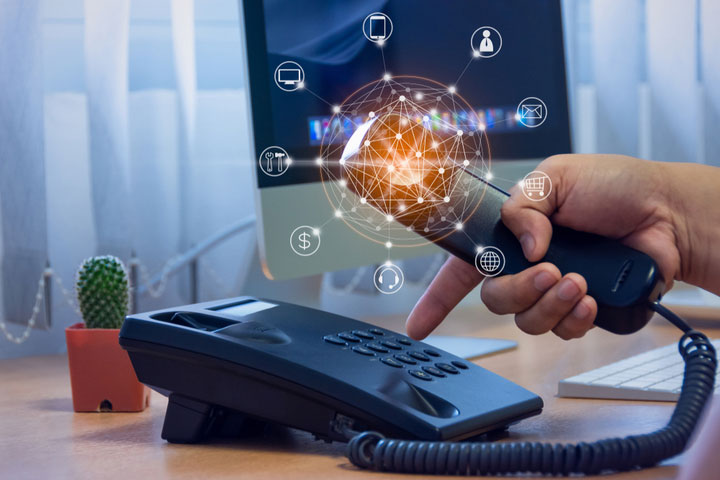
Instead of traditional phone lines, voice calls use IP packets to transmit audio over the Internet — think Skype, Zoom, or WhatsApp calls.
3. Video Streaming
Platforms like YouTube, Netflix, and Twitch rely on IP technology to deliver high-quality video with minimal buffering.
4. Smart Devices and IoT
From smart thermostats to security cameras, all these gadgets connect via IP-based networks.
5. Cloud Computing
Services like Google Drive, AWS, and Microsoft Azure depend on IP networking for remote storage and data access.
6. IP Surveillance Systems
Modern security cameras use IP networks to transmit footage digitally, allowing remote access and high-definition recording.
Advantages of IP Technology
Let’s break down why IP technology is so revolutionary:
-
Scalability: Easily supports growing numbers of connected devices.
-
Flexibility: Works across wired, wireless, and hybrid networks.
-
Cost-Effectiveness: Reduces the need for traditional cabling or separate systems for voice and data.
-
Interoperability: Works across various platforms and vendors.
-
Global Standardization: Provides a universal communication protocol.
Challenges and Limitations
Despite its strengths, IP technology isn’t without hurdles:
-
Security Risks: IP networks are vulnerable to hacking, spoofing, and DDoS attacks.
-
Address Shortages (IPv4): Limited number of IPv4 addresses causes connectivity issues.
-
Network Congestion: With billions of devices online, traffic management is crucial.
-
Latency: Long-distance routing can cause slight delays.
-
Configuration Complexity: Large networks require expert management and configuration.
Future Trends in IP Technology
The evolution of IP technology continues to reshape global connectivity. Here’s what’s coming next:
1. IPv6 Dominance
As IoT grows, IPv6 will replace IPv4 entirely, offering faster, more secure, and seamless device communication.
2. 5G Integration
5G networks rely heavily on IP for high-speed data transfer, powering smart cities, autonomous vehicles, and AR/VR systems.
3. Network Automation
Artificial intelligence (AI) and machine learning will automate IP routing and management, reducing human error.
4. Enhanced Security Protocols
Next-gen encryption and IPsec (Internet Protocol Security) improvements will make IP communication more resilient to cyber threats.
5. Edge Computing
By processing data closer to its source, IP technology will cut latency and boost real-time performance in critical applications.
How IP Technology Shapes Everyday Life
Let’s be honest — most of us don’t think about IP technology, but it’s literally everywhere:
-
When you send a WhatsApp message, IP protocols ensure it reaches the right device.
-
When you stream a movie, IP packets carry that data in real time.
-
When you use GPS, IP-based communication links satellites, servers, and your phone.
Without IP, there would be no Internet as we know it — no email, no online shopping, no cloud storage, no social media.
IP Technology in Business
For businesses, IP technology is the key to digital transformation:
-
Unified Communication: Integrates voice, video, and data networks into one system.
-
Remote Work Enablement: Supports VPNs and secure online collaboration.
-
Cost Reduction: Eliminates the need for separate infrastructure for voice and data.
-
Data Analytics: IP-based systems provide valuable insights through traffic analysis.
-
Customer Service: Enables chatbots, VoIP-based call centers, and AI-driven support tools.
Security in IP Technology
As more systems go online, IP security (IPsec) becomes vital. It offers:
-
Data Integrity: Ensures packets aren’t tampered with.
-
Authentication: Confirms the identity of communicating devices.
-
Encryption: Protects sensitive data during transmission.
Firewalls, VPNs, and intrusion detection systems all rely on IP security frameworks to safeguard networks.
Conclusion
In a world connected by billions of devices, IP technology is the lifeblood of communication. It’s what enables the seamless exchange of data — from your morning alarm app to global corporate systems.
The shift from IPv4 to IPv6, integration with 5G, and the rise of IoT are propelling IP technology into an even more exciting future. As everything becomes smarter and more connected, IP will continue to evolve — quietly working behind the scenes, ensuring that the digital world never stops talking.
